
Standard rehabilitation protocol courtesy of Christopher Shultz, M.D.
Basic Exercises
You should wear your sling full time for the first 4 weeks, and when out of the house or sleeping from weeks 4-6. You should take off your sling at home starting post-operative day 2 and perform the following exercises 3-4 times per day, 10 sets at a time. Make sure you can see your elbow at all times when doing these exercises. Reaching behind your back can cause your shoulder to dislocate.
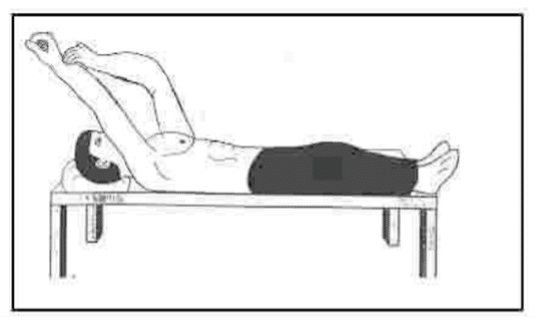
1. Supine forward flexion: Lie on your back. Hold the affected arm at the elbow with the opposite hand. Assisting with the opposite arm, lift the operated arm upward, as if the bring the arm overhead. Slowly lower the arm back to the bed. Repeat 10 times per session.
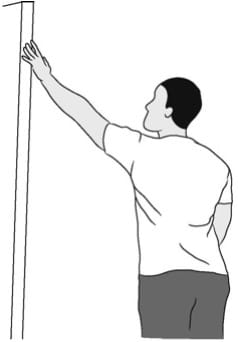
2. Wall walks: stand with your shoulder about 2 feet from the wall. Raise your arm to shoulder level and gently “walk” your fingers up the wall as high as you can. Hold for a few seconds. Then walk your fingers back down. Repeat 10 times. Move closer to the wall as you repeat. Build up to holding each stretch for 30 seconds.
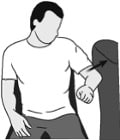
3. Isometric shoulder abduction (the chicken wing): Resisting upward motion to the side, slowly and gently push your arm against the back of chair. Hold for 5 seconds, and then relax. Repeat 10 times per session.
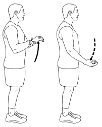
4. Elbow stretch: 3 times per day, remove your sling and let gravity stretch your elbow full straight. Repeat this 10 times per session.
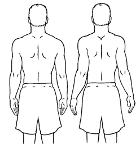
5. Posture: When you no longer need to wear your sling, it is important to stretch your back and shoulders to regain your pre surgery posture. Posture is important especially for a good functioning shoulder. Gently roll your shoulders a few times and squeeze your shoulder blades together. Gently hold this position for 10 seconds.
Physical Therapy Protocol
Phase I (surgery to 4 weeks after surgery)
|
Rehabilitation goals
|
Reduce pain and swelling in the shoulder after surgery Maintain active range of motion (AROM) of the elbow, wrist and neck Protect healing of repaired tissues and implanted devices |
|
Precautions
|
Use sling continuously except while doing therapy or light, protected activities – such as desk work, for 4 weeks Wear sling while sleeping for 6 weeks OK for active assist forward flexion No active internal rotation for 6 weeks External rotation range of motion limited to 30 degrees Relative rest to reduce inflammation |
|
Suggested therapeutic exercises
|
Elbow, wrist and neck AROM Ball squeezes Passive and active assistive range of motion (AAROM) for shoulder flexion and abduction to patient tolerance Codmans/Pendulum exercises Pain free isometrics for shoulder flexion, abduction, extension and external rotation |
|
Cardiovascular exercise
|
Walking or stationary bike with sling on No treadmill |
|
Progression criteria |
4 weeks after surgery |
Phase II (begin after meeting Phase I criteria, usually 4-8 weeks after surgery)
|
Rehabilitation goals
|
Controlled restoration of passive and active assistive range of motion Activate shoulder and scapular stabilizers in a protected position of 0 degrees to 30 degrees of shoulder abduction Correct postural dysfunctions |
|
Precautions
|
No lifting anything heavier than a coffee cup Wean out of the sling slowly based on the safety of the environment during weeks 5 and 6. Discontinue use of the sling by the end of week 6 Wear sling while sleeping for 6 weeks No active internal rotation for 6 weeks External rotation range of motion limited to 30 degrees weeks 5 and 6, then to 45 degrees for weeks 7 and 8 |
|
Suggested therapeutic exercises
|
Passive and active assistive range of motion for the shoulder in all cardinal planes Pain free, progressive, low resistance shoulder isotonics Gentle, low velocity rhythmic stabilizations to patient tolerance Scapular strengthening with the arm in neutral Cervical spine and scapular active range of motions Postural exercises Core strengthening |
|
Cardiovascular exercise
|
Walking or stationary bike No treadmill or stair master Avoid running and jumping because of landing impact |
|
Progression criteria |
8 weeks after surgery |
Phase III (begin after meeting Phase II criteria, usually 8 weeks after surgery)
|
Rehabilitation goals
|
Functional shoulder range of motion in all planes Normal (rated 5/5) strength for shoulder internal rotators and external rotators with the shoulder in 0 degrees of abduction Correct any postural dysfunction |
|
Precautions
|
External rotation range of motion limited to 60 degrees No lifting more than 15 pounds |
|
Suggested therapeutic exercises
|
Shoulder internal rotation and external rotation with theraband or weights that begin at 0 degrees of shoulder abduction-gradually increase shoulder abduction as strength improves Open kinetic chain shoulder rhythmic stabilizations in supine (ie. stars or alphabet exercises) Gentle closed kinetic chain shoulder and scapular stabilization drills-wall ball circles and patterns Proprioceptive neuromuscular facilitation patterns Side lying shoulder flexion Scapular strengthening Active, active assistive and passive range of motion at the shoulder as needed Core strengthening Begin trunk and hip mobility exercises |
|
Cardiovascular exercise
|
Walking or stationary bike No treadmill or stair master Avoid running and jumping because of landing impact |
|
Progression criteria |
12 weeks after surgery |
Phase IV (begin after meeting Phase III criteria, usually 12 weeks after surgery)
|
Rehabilitation goals
|
Normal (rated 5/5) rotator cuff strength and endurance at 90 degrees of shoulder abduction and scaption Advance proprioceptive and dynamic neuromuscular control retraining Achieve maximal shoulder external rotation (no limitations) Correct postural dysfunctions with work and sport specific tasks Develop strength and control for movements required for work or sport |
|
Precautions
|
Soreness should go away within 12 hours of activities |
|
Suggested therapeutic exercises
|
Multi-plane shoulder active range of motion with a gradual increase in the velocity of movement while making sure to assess scapular rhythm Shoulder mobilization as needed Rotator cuff strengthening in 90 degrees of shoulder abduction and overhead (beyond 90 degrees of shoulder abduction) Scapular strengthening and dynamic neuromuscular control in open kinetic chain and closed kinetic chain positions Core and lower body strengthening |
|
Cardiovascular exercise
|
Walking, stationary bike or stair master No treadmill or swimming Begin light jogging and running if patient has normal (rated 5/5) rotator cuff strength in neutral and normal shoulder active range of motion |
|
Progression criteria |
Full shoulder active range of motion in all planes and multiplane movements |
Phase V (begin after meeting Phase IV criteria, usually 18 weeks after surgery)
|
Rehabilitation goals
|
Normal strength and endurance of deltoid at 90 degrees of shoulder abduction and scaption Advance proprioceptive and dynamic neuromuscular control retraining Correct postural dysfunctions with work and sport specific tasks Develop strength and control for movements required for work/sport Develop work capacity cardiovascular endurance for work/sport |
|
Precautions
|
None |
|
Suggested therapeutic exercises
|
Multi-plane shoulder active range of motion with a gradual increase in the velocity of movement while making sure to assess scapular rhythm Shoulder mobilization as needed Rotator cuff strengthening in 90 degrees of shoulder abduction as well as in provocative positions and work/sport specific positions, including eccentric strengthening , endurance and velocity specific exercise Scapular strengthening and dynamic neuromuscular control in overhead positions and work/sport specific positions Work and sport specific strengthening Core and lower body strengthening Work specific program, golf program, swimming program or overhead
|
|
Cardiovascular exercise
|
Design to use work/sport specific energy systems |
|
Progression criteria |
May return to sport after receiving surgeon, athletic trainer of PT clearance Return to sport are based on meeting the goals of this phase
|
