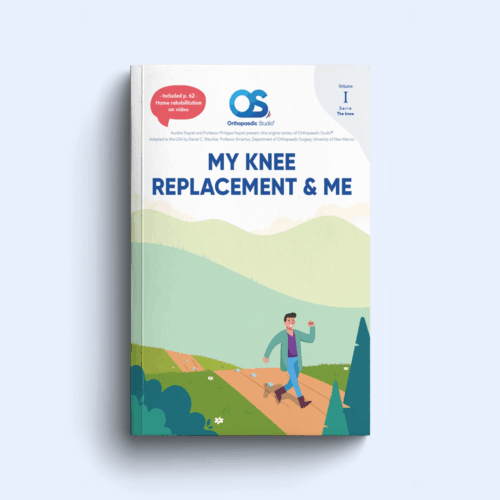
Understand how the meniscus works and what to expect during hospitalization.



You have knee pain or a meniscal injury.
You are about to undergo meniscus surgery or have recently had it.
You’re looking for a simple, illustrated, and reliable guide to understand your knee and your injury.
You want to take an active role in your rehabilitation and reduce the risk of long-term complications.
Why this book is right for you:

Author

Pr Philippe Neyret
Discover everything about the meniscus and the recovery process.
Dive into the details of the meniscus with our comprehensive guide, written by a scientific committee including Professor Philippe Neyret, a renowned orthopedic surgeon, Aurélie Neyret, coordinating nurses from STUDIOSANTÉ®, expert physicians, and a legal specialist.
In this guide, you will find an in-depth analysis of meniscus injuries, as well as the nuances of their surgical management. You will also gain a complete overview of the hospitalization process and patient care, including the different post-operative stages. Practical advice is provided to help you optimize your recovery, relieve pain, and regain mobility. Finally, this bound and easy-to-read document is an essential resource for anyone affected by meniscus injuries.
Get your copy now to better understand and manage your knee.
Examples of questions answered in My Meniscus & Me:
Traumatic medial meniscus injury associated with an ACL tear
A traumatic internal meniscus injury associated with an anterior cruciate ligament (ACL) tear usually occurs at the time of the accident. It often presents as a vertical peripheral tear in a well-vascularized “red zone,” which has healing potential. Diagnosing a meniscal lesion can be challenging due to the sprain and pain that limit clinical examination.
To confirm the diagnosis, MRI or arthroscopy is required. However, in practice, establishing a clinical diagnosis at this stage is not always urgent. During the initial phase of ACL tear management, this type of lesion often tends to heal spontaneously. A few weeks later, treatment focuses on the ACL tear, which may have become chronic with anterior laxity.
In some cases, a meniscal fragment may become displaced in the knee, causing locking and preventing extension (known as a “bucket-handle tear”). To unlock the knee and preserve the medial meniscus, early simultaneous reconstruction of the ACL and the meniscal lesion is performed.
Medial meniscus injury: accident or degenerative condition?
A traumatic meniscus injury occurs in a knee without osteoarthritis. It is essential to determine whether the lesion is isolated or associated with an ACL tear. A ligament rupture significantly changes the treatment approach and often requires surgical intervention.
Degenerative meniscus lesions occur as part of age-related joint changes, typically beginning around 35–40 years old. Conservative treatment is usually recommended first. If unsuccessful, arthroscopic surgery may be considered.
Meniscal lesions can take different forms. Sometimes, cases fall into a grey area—often in patients over 40, 55, or even 60 years old. Symptoms may appear during rotational movements, such as getting out of a car or playing tennis. MRI may reveal a meniscal fragment, suggesting trauma on an already degenerative meniscus.
A thorough knee examination, additional imaging (X-rays, MRI), and the surgeon’s expertise are essential to determine the most appropriate treatment. The goal is to avoid unnecessary surgery while also preventing delays in effective care.
And more:
-
What are the outcomes after meniscal repair?
-
What happens after arthroscopic partial meniscectomy?
-
Why perform X-rays when an MRI has already been done?
Weight: 0.596 kg
Dimensions: 21 × 2 × 30 cm
Number of pages: 96 pages
Add a review
 My meniscus and me
Your review
* Review is required
Name
* Name is required
Email
* Email is required
| 5 star | 0% | |
| 4 star | 0% | |
| 3 star | 0% | |
| 2 star | 0% | |
| 1 star | 0% |
0 of 0 reviews
Sorry, no reviews match your current selections